Wednesday, January 26, 2011

Ethiopia – land of breathtaking mountains, rock hewn churches and valuable lessons in how not to do foreign aid

It was here that Lucy was discovered by archeologists. Lucy was a special species that already 3.2 billion years ago walked on 2 legs and destroyed the scientists’ previous theory that our ancestors only started walking on 2 legs after evolving larger brains. Lucy became famous and Ethiopia started being considered as “the cradle for humanity”. And then a complicated, varied and fascinated history followed of acient kingdoms and religions, Muslim and Christian wars, brutal bloody conflicts with its invadors and neighbours, insane emperors, famine. You name it and it probably featured in Ethiopia’s history... The Ethiopians of today are extremely proud people – of their language, heritage, religion, culture, calendar (in Ethiopia the calendar says it’s 7.5 years earlier than everywhere else and the clock says it’s 6 hours earlier). 3 words summarize my first impressions of the country – religion, agriculture and injera (large, pancake-like local type of sour bread, which – although it looks like an old kitchen flannel - you better learn to like and quick because it will be the basis of almost every meal you’ll have in Ethiopia). My second impression of the country was that it’s a sad but at the same time valuable lesson in how not to do foreign aid. There are overwhelmingly many children around Ethiopia – big towns and tiny villages alike – who spend their entire days chasing any foreigner they can find with an aggressively extended hand commanding “give me money, give me money”. And if this demand is not met, it’s not unheard of that stones and human number 2 (aka poop) is thrown at you or your car. I find it beyond depressing that the immediate association they have of seeing a white face is to be handed out money for nothing, that they are on the streets begging instead of being in school or at least attempting to provide some kind of service (showing the way, polishing shoes, selling something) in order to earn the money. For me it is such a “in your face” cruel reminder that handing out food or money to the communities in Africa is not the right way to do foreign aid. It’s not sustainable and it’s not aiding. It’s crippling those communities for generations. It makes them dependant on and addicted to aid. It doesn’t teach them or motivate them to actually learn a skill and use it to sustainably support themselves.

Gondar –

Royal Enclosure – entire 70,000 sq ft complex was totally restored by UNESCO and made a World Heritage Site. Most impressive and best preserved elements are Fasiladas Palace with its Indian, Portugese, Moorish and Aksumite influences, Palace of Iyasu I with its banquet hall, library and kitchen. There’s also a Turkish bath, which evidently worked wonders for those suffering from syphilis.

Fasiladas Bath – large pool (about the size of an Olympic size pool) surrounded by beautiful stone walls and snakelike tree roots used to be a swimming pool for royalty (who used inflated sheep skins as life jackets) and today is a place of religious christening rituals. Once a year it’s filled with river water, blessed by a priest, and becomes a loud riot for hundreds of people jumping in and splashing around.

Whole of Gondar has quite a bloody and brutal history including characters like a queen who slayed a king’s brother and was dangled on a rope from a tree outside the Royal Enclosure, or dead bodies of many rebels who challenged of the ruling authorities and were layed in the open to be chewed on by hyenas, or the kings who held banquets of fiesting on raw flesh while wearing their crows of emeralds and jewels.

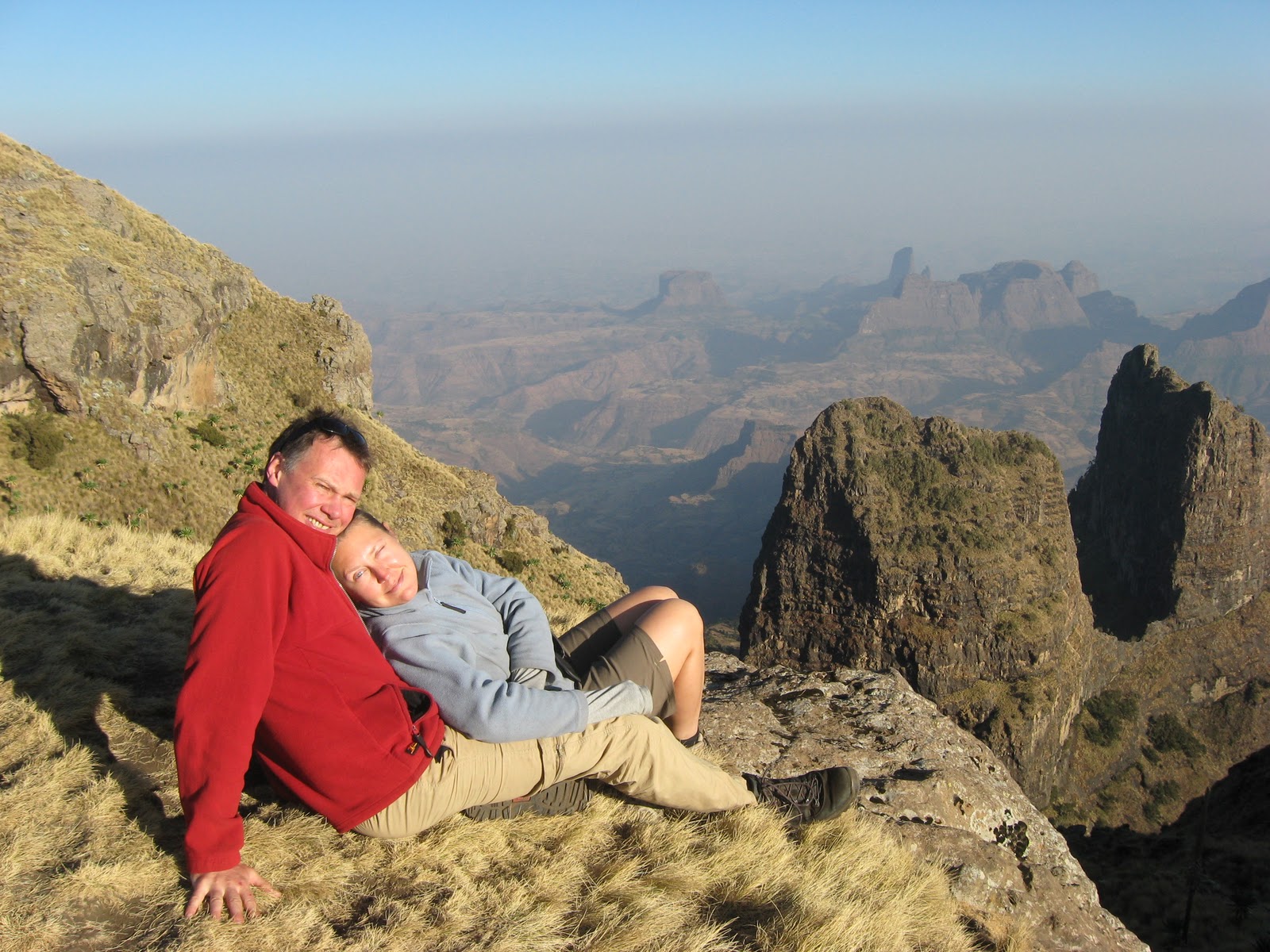
Simien Mountains National Park – no matter what treks and routes you choose to cover in this national park, whether you will spend a day or a week here, it will leave you completely breathless. The peak go up to 4000 m so altitude with leave you speechless. Coming across groups of gelada baboons on your treks is always an adventure. Spending New Year’s Eve on top one of the mountain peaks (as I was fortunate to do) is definitely a memorable (and freezing cold!) experience. The Simien Mountains definitely rank among Africa’s best mountain ranges. The most popular camps are Cheech (about 3400 m) and Chenek (about 3700 m, has a feel of Mt Everest base camp, the place of my New Year’s Eve celebrations – if going to bed at 7 pm because it’s too cold to feel my fingers counts as celebrations). Best peak we’ve trekked to is Imet Gogo (3926 m) – wall of rock, from which you’ll get absolutely best views of the mountains. Sitting on Gogo’s top looking down on the world will definitely put you in the state of utter and complete amazement over the beauty of out planet and will make all these hours of hard trekking more than worthwhile. 


Aksum – riddle waiting to be solved. Did the Queen of Sheba really live here? Do they really have here the same Ark of Covenant that Moses carried down Mt Sinai? What do those famous stelae mean?  Aksum – although no longer wealthy and powerful – is still a spiritual capital of Ethiopia and many pilgrims still make it here every year for their religious celebrations.  All Ethiopians believe very passionately that the Ark of Covenant resides here. The whole town is a UNESCO Word Heritage Site and one of the best ones in Africa at that. The amazing St Mary of Zion Churches are well worth a visit and not just because the famous Ark of Covenant may or may not be stored here. But the seriousness with which the Ethiopians take the security around those Churches makes you think “there must be something really valuable inside”. Only one specially chosen guardian has access to the Ark, nobody is allowed near the chapel and foreigners are not even allowed close to the fence surrounding the building.

Lalibela  - more amazing and pictureque than any stories you may have heard or photos you may have seen. The legend has it that a poisoned man was taken by angels to heaven where he was shown a city of rock hewn churches and then ordered by God to go back to Earth, re-create what he had seen and establish a new Jerusalem. Lalibela has 11 ancient churches, carved from rock (by estimated workforce of 40,000 men who worked by daylight and claimed that Godly force continued their work during the night), and visit to each one is a memorable experience of Christianity in its most raw form. The unforgettable atmosphere is also created by the dim-lit passageways (bring a torch or run a risk of breaking a leg), hidden grottoes and crypts. I was extremely fortunate to visit Lalibela around Ethiopian Christmas time (Jan 8) and all the churches were being actively used by the local priests, white-robed pilgrims and people getting baptised. 

Rift Valley National Park – just north of a town called Shashamene are 2 of the most beautiful of the Rift Valley Lakes, Lake Abiyata and Lake Shala. Abiyata is one of the shallowest in the Rift Valley and is a soda lake. It’s home to flamingos, white pelicans, cormorants, ibises and many other species of birds. And I was fortunate enough to be bush camping on a hill overlooking both lakes! It made for one stunning sunset – and that’s despite about 50 local kids who quickly gathered around us to stare, beg and even throw one of my fellow travelers out of her hammock so they could use it J

Shashamene – this little town has quite a few unusual attractions to offer. It’s a spiritual home to a large Rastafarian community with their interesting philosophy, unique churches, and affordable marihuana for sale which of course I did not try, dear mum (although grapes and wine are illegal). Haile Selassie was a Rastafarian himself and he granted land to them in Shashamene. As a result, there are now about 100 families settled here, some of them relocated from the Caribbean to Ethiopia. There’s also a banana art gallery here, evidently the only one in the world, where a renowned Rastafarian artist who relocated here from a Caribbean island of St Vincent makes beautiful paintings, postcards etc nothing but banana plants and leaves. However, my absolute favorite attraction of Shashamene were the hot springs just outside of town. We camped across the street from the hot springs so spent the whole evening swimming and relaxing in several large swimming pools, each of different temperature but all very hot. It was bliss to feel clean and scrubbed again after days of no water or showers J

Robe – this is a tiny town where we stayed for couple nights on route to the Omo Valley Region. There aren’t any attractions here worth mentioning but there’s one funny travel memory I’ll forever have of this place – and I like to call it the “ghost hotel”. It’s a little hotel where we stayed since there weren’t any suitable and safe spots to camp in the area. From the outside this hotel looked actually quite civilized and nice. There were even 2 UN cars parked in front of it, so I got all excited that there’ll be luxury amenities like hot water and proper working toilets (since UN and other big NGOs are always seen staying in the best accommodations in town – you should have seen the 5 star hotel in Khartoum, Sudan where they were all staying before the Sudanese referendum! Room prices start at $400 there, presidents and celebrities stay there – and UN employees…). Inside the hotel however it was an entirely different story and the standard of amenities was so horribly appalling, I just had to laugh. Otherwise I would be crying but what’s the point of that… It was a bizarre place. Nice looking building, large clean looking rooms but nothing worked. It’s like they never quite finished building it. There was absolutely no water in the whole hotel for most of the time (except couple hours a day when there was a trickle of cold water coming from my shower). This means no water in the toiler, sink or shower. I washed with a water bottle, flushed toilet with a water bottle. All bathrooms stunk like sewage because evidently the hotel didn’t yet have a proper sewage tank system build. Soon the cockroaches arrived… And to top things up, there was no electricity either… It was indeed like a ghost hotel – it seems to be a proper hotel but no hotel facilities were really there except a bed. It was a surreal experience staying there. And let me tell you, it didn’t really help matters when at the same time Cute Dutchman was calling me from his business trip to Dubai excitedly telling me stories about how amazingly fancy the hotel room was where he was staying – stairs leading from hallway to huge living room, another set of stairs leading from the living room to huge bedroom, breathtaking shower and bubble bath, Balinese massages etc etc etc etc. And there I was – lying on my bed in the complete darkness (because no electricity), with oily dirty stinky hair (because not enough water to wash it), with zero privacy from scary creepy local men (because room door always open to get rid of sewage stink coming from the bathroom), never venturing to the bathroom without a shoe in my hand (because of cockroaches). As much as I try to be a supportive understanding girlfriend sharing the joys of my man, these couple days I really couldn’t muster enough good energy in me not to be jealous of his fancy hotel room in Dubai while I was staying in the stinkiest one in Ethiopia… Cute Dutchman with his “oh my God, I love my hotel room” stories was not my favorite person in the world at the time… But he promised he will make it up to me but taking me to some extra nice hotel somewhere for few days where I’ll get pampered beyond belief. So I forgave him J

Tribes of Omo Valley in Southern Ethiopia – there aren’t enough words to describe the overwhelming feelings of meeting the tribal people. It will forever be one of the most unforgettable travel experiences of my life. Those people live in remote parts of the Ethiopian bush, still practicing their own language, medicine, agriculture, religion and spirituality like they did for centuries, completely independent from and unaware of the rest of the world. One of my favorite tribes is Homer tribe. We were fortunate enough to obtain permission from their chief to bush camp for couple nights on their land, near one of their villages, so got to spend lots of time with them, got invited to the chief’s hut for a coffee ceremony and met his wives. Extraordinary culture. Homer women are renowned for their remarkable hairstyles called “goscha” (they rub ochre and water into their hair to make it slick and then twist it into red tresses). Homer are also famous body decoration masters. There’s a special tribal meaning to every piece of jewellery, scars or tattoos one wears (e.g. number of earrings on a woman indicates number of wives her husband has and where in the hierarchy she falls, iron rings around a woman’s neck indicate she’s married or engaged, number of scars on a woman’s body indicate her beauty status – the more scars, the more sensual she’s considered). The tribe chief was telling us some fascinating stories about Homer culture. Some of them may shock us Westerners but this is how Homer choose to live and they reject any Western forces disguised as charitable help to change them. Virgins will not find anyone to marry them in Homer culture – it’s believed that if nobody has shown sexual interest in a girl, then there’s something wrong with her and she’s not suitable marriage material. So from young age girls go into the bush with various tribe man to have sex. The more sexual partners the girl has, the more beautiful and popular she’s regarded in the village. There’s no Western education at all – men are taught to be warriors, providers and hunters, women are taught to be wives and mothers. Homer don’t believe in Western medicine: they gather all their medicine from the bush plants, all childbirth is done naturally with a help of a village midwife. Some European NGO came years ago and built a small brick building where Western nurses would come every few weeks and tribe members could get tested and treated for various diseases. Well, nobody asked Homer is they even wanted this kind of “help” – turns out they do not, building crumbled to ruin and donor money got wasted. I have seen so many examples of such completely failed and misguided NGO help throughout Africa…

Other tribes we have seen are Konso (with their famous villages with narrow stone and stick alleys and beautifully constructed stone terrace fields known as ”wagas”), Karo (most endangered, famous masters of chalk body painting), Banna (with their fascinating ritual of decorating body in clay and having a village feast after killing a bull).


Sudan – tales of sand in every form known to man, beautiful women in colourful chadors and creative ways to stay clean without water


My first impression of Sudan – 20 hour ferry crossing from Aswan in Egypt to Wadi Halfa in Sudan - was a  very “travelling like the locals do” experience (and those who have survived this particular journey will understand exactly what I mean): more dirty, smelly, crowded and noisy than I expected in my wildest dreams, and freakishly unsafe if measured by Western standards. But at the same time what a fascinating and unforgettable adventure! Amidst disgustingly smelly toilets, food I wouldn’t touch with a stick and hundreds of slightly creepy local men I kept thinking to myself: “if I can do this, I can do anything!” J

Let me tell you a bit about this ferry crossing to allow you fully appreciate the local customs J First I completed the patience-testing immigration and customs procedures, which consist of walking from a building where they check your bags to a window where they stamp your passport to a little hut where they give you the immigration forms to another little hut where they make you stand in line for a very long time and then look at your passport for seemingly no reason whatsoever. And so forth... You get the picture... After the immigration paperwork I went to a little harbour where the ferry was being loaded. Hmmm, ferry is a big name for the small, rusting, shaky boat I saw. In my humble assessment it can probably semi-safely fit about 100-150 people and there were 500 passengers booked to travel on it. And majority of those 500 passengers were locals. And if you’ve ever travelled in Africa you know what insane amounts of luggage the locals travel with. So imagine 500 people with their screaming children and their tens of boxes, suitcases, refrigerators, TVs, cartons of food etc being cramped onto this poor little boat. How we all fit onboard defies logic and if I haven’t seen it with my own blue eyes, I would have never believed it. But we all fit and off to Sudan we went... On the ferry we had booked cabins in something the locals call 1st class, which turned out to be tiny 2 person cabins with a bunk bed and blankets with access to a communal toilet in the corridor. Blankets were so dirty that we wrapped ourselves in our own sleeping bags being extremely careful not to make any skin contact with the bed or blankets. Toilets were so dirty and smelly that we basically decided not to eat anything and drink very little to avoid having to use the toilet. But let me tell you, all this was still 1st class compared with what the 2nd class looked like: hundreds and hundreds of people with their tons of luggage cramped onto the top deck of the ferry. Sleeping and eating on the floor. In scorching heat during the day and freezing cold at night. Absolutely horrendous! I consider myself a fairy good traveller who’s prepared to rough it up when required but without my 1st class cabin I would have been crying the entire 20 hours from Egypt to Sudan!

When we finally arrived in Sudan , we spent couple of days in the port village of Wadi Halfa waiting for our truck to get there (as it went on a separate and much slower vehicle-only barge). Wadi Halfa consists of about 5 streets and couple of very basic hotels. It has a waiting room ambience to it because everyone here is waiting either for their ferry to Egypt or for their cars to arrive from Egypt. Nothing to do but chill, wander about, read and start getting used to bucket showers. It was also my first experience of how amazingly friendly and warm the Sudanese people are. Not aggressive towards “rich” white foreigners at all, very calm and always smiling. I loved hanging out in the cafes of Wadi Halfa, drinking tea, smoking water pipe and chatting with the locals.

From Wadi Halfa my overlanding adventure of crossing Sudan began. 2 weeks of bushcamping with LOTS of sand, going to the toilet behing the closest sand dune and without showers and hot water! Loved it! This is what I came here for! What an amazing life lesson in learning to appreciate clean Western toilets and proper hot-water showers. But fear not: I didn’t go smelly and dirty for 2 weeks. One invents very creative ways to stay semi-clean in the Sudanese desert: using water from any kettle, bowl, water bottle etc one can find J And if it proves impossible to find any water at all, wet wipes are handy (lots and lots of them should feature of a pre-departure shopping list of any traveller to Sudan).

Since it’s impossible to fully describe the beaty and spirit of Sudan in a brief travel blog, I’ll limit myself to a summary of the most interesting places I had privilage to visit. For the full experience you’ll just have to visit yourself one day...

Dongola – 500 km from Khartoum, the capital of Sudan’s northern state. A true burst of greenery on the River Nile. It has a unique oasis-in-the-desert feel to it wit hits abundance of green trees and plants, well watered fields and its agricultural wealth from the cultivation of date palms. It even has an airport! Mothballed a long time ago but still... And we found ice cream in one of its littl street shops! Paradise on the Nile.

Temple of Soleb – one of the best preserved Egyptian temples on the Sudanese Nile. Built by Amenhotep III in 14th century BC, dedicated to the lord of Nubia, who was thought to be a representation of the pharaon himself. Today the temple consists of scattered blocks of 2 pylons, hypostyle hall , court and a sanctuary. It’s estimated that when it was complete it would have been 130 m long.  In its feel and architecture it’s similar to the Temple of Luxor. The dingy ride across the Nile to reach the temple and the absence of any other visitors added to the romantic serene appeal of the place...

Kerma – market town sandwiched in between 2 deserts. One of the hottest places on Earth. Around it there are a number of small mud-hut villages and not much else. Navigating through its narrow alleys of picturesque huts and distructed from the map by the super-friendly locals coming out from the fields to shake our hands we got  a tiny bit lost, which provided for couple hours of great adventure of driving through the surrounding villages, waving back at the locals and not really knowing where the heck we’re going. Great fun.

Western Defuffa – famous for its impressive (and hard to find, hence the above-mentioned getting lost) 3500 old mud-brick ruin, which used to be the seat of the independent Kingdom of Kush. This ruin is the oldest and largest manmade structure in subsaharan Africa. “Deffufa” means “mud brick building” in Nubian and this name pretty much describes what you’ll find there today: big mud ruin, beaten by the years of harsh weather. One single staircase leads to the roof where there probably used to be a shrine of some sort. The funny memory I’ll have of this place is the fact that this place – completely in the middle of nowhere and with nothing valuable to steal (who wants to steal mud or sand? Plenty of that in Sudan) it was guarded by a group of police and army officers, fully geared with uniforms and guns! Why??? Soviet attitude of “everyone will have a job, regardless of how unnecessary the job actually is”???

Eastern Defuffa – famous of its graves of Kerma kings. The cementeries with about 3000 graves found here have been the main source of knowledge for scientists about the Kerma culture. From studying the graves the archeologists have found that bodyguards, wives, servants and children were buried along with the kings. One royal tomb  contained over 300 sacrificial victims – including cattle in large numbers - accompanying the king to the afterlife. Kerma culture seems to have been a very bloody one...

Jebel Barkal – considered a holy mountain by the Sudanese. Ancient Egyptians and Kushites believed it to be a home of God Amun and a throne of 2 lands: Egypt and Nubia. There are remains of Temple of Amun dating back to 15 centure BC on the foot of the mountain. There is also a small royal cementary of about 20 Nubian pyramids.

Nuri pyramids – another famous cluster of Nubian pyramids in the Sudanese desert. Much much smaller than their Egyptian equivalents but amazing pieces of architecture nevertheless.

Khartoum – as I mentioned previously somewhere in this blog, I normally am not too impressed by big African cities by I must admit that my experience of Kharoum was quite a pleasant one. It’s walkable, safe (providing you can get used to and unbothered by local soldiers on every corner pointing big machine guns in your direction – they claim they’re there for your safety...) and quite an interesting mix of modern and traditional architecture. And – what a girly admission to make – my stay in Khartoum was made extra amazing by multiple visits to a 5 star spa in a 5 star hotel (where I was NOT staying – rooms start at 250 dollars and go all the way to 4000 dollars) – I spent 2 days getting full body scrubs, massages, chilling in swimming pool, jacuzzi, sauna and steam room. BLISS!!! HEAVEN!!! PARADISE!!! Not too shabby for a dirty and budget consious overlander that I normally am. And yes, while the cost of this spa paradise was way above my normal travel budget I allow myself on this trip, what a way to treat myself for Christmas after weeks of dirty, waterless, showerless and toiletless camping in Sudan!

But above all my experience of Khartoum was made special by an experience of a completely different nature: going to church. I consider myself extremely fortunate to spend Christmas Eve in Khartoum because this lucky timing allowed me to add another completely unforgettable travel experience to my already bulging bag of experiences: attending Christmas Eve midnight mass in a Catholic cathedral here. To accomodate hundreds and hundreds of worshippers (among whom I counted only 7 white faces – including mine) the mass took place in a bog outdoor courtyard just outside the cathedral. There was amazing music performed by a local choir and band: standard Catholic songs and anthems performed in a highly unusual mix of English, Latin and local languages, and with a strong African musical atmosphere (shouting, crying, laughing and dancing). Definitely an experience that brings tears of gratitude and awe to your eyes even if you’re not religous at all... 

Monday, December 6, 2010

Egypt: the Pyramids just as we imagined them as kids and the desert that makes you heart cry with happiness

Cairo: situated on the banks of River Nile and the largest city in Africa, I must admit the city did not impress me. To be fair, I'm not a fan of big cities anyway, let alone African big cities (which from my experience are particularly uninspiring and sometimes plain offputting with the exception of my beloved Cape Town) but Cairo did not strike me at all as a place I'd want to live in. I spent a week here and it was more than enough. Sure, there are several attractions here you would not want to miss, like the Pyramids and the Sphinx at Giza, the Egyptian Museum, the Citadel, the Khan-el-Khalili bazaar. They were all pretty amazing and absolutely worth visiting. The Pyramids are as breathtaking as we have all imagined them to be since we were little kids learning all about the fascinating culture of Ancient Egypt in school. But the place, which took my breath away most and made a lasting impression on me is definitely the Egyptian Museum (which I had the pleasure of living only about 3 min walk from). It's the biggest sinlge attraction within the city center. The sprawling sandstone building on Tahrir Square (which - strangely - during the day is peach coloured and in the evening orange coloured!) is packed with antiquities: mummies including the pharaohs Ramses II and III and Seti I, the contents of the tomb of Tutankhamen’s (King Tut) and many many other highlights from the oldest of civilizations. And don’t overlook the excellent collection of Greek and Roman artifacts either! And even the hordes and hordes of tourist, which I would normally consider an utter nightmare and run away from screaming, did not put me off from spending a day wandering around the museum with my mouth wide open in awe and wonder. Just imagine how fascinating it much have been for Carter and his archeology team when they discovered the Tutankhamen's tomb and all the priceless treasures inside it!!! As an archeologist you spend years in school and laboratories and digging in dirt, often without ever finding anything of value. For years everyone around you tells you that you're a silly impractical dreamer for believing in fairytales about the hidden treasures of ancient kings. And then imagine how Carter must have felt when he discovered what he discovered in Egypt and became world famous overnight!!! This is the prize for relentlesly following one's dreams despite doubt and challenge from everyone around...
White and Black Desert: travelling through the desert is uniquely romantic. No matter what desert in the world you're crossing, being in the middle of nowhere, surrounded by solutide and wilderness, emersed in complete silence and camping overnight under the sky lit up by millions of stars - if all this doesn't bring tears of awe and gratitude in one's eyes, I don't know what will. But the Egyptian Western Desert is unique. The Black Desert is a region of volcano-shaped mountains with large quantities of small black stones. The stones lie out across the orange-brown ground, so that it is not quite as black as many people may hope for. In the White Desert the rock formation are really white, which creates an especially dramatic landscape of mushroom-shaped white rocks ranging in heigh from less than a meter to several meters and spread out in the yellow desert sand as far into the horizon as you can see. At sunset climb the nearest hill (or the truck roof!) and admire the beauty of the world we live in... Don't forget the camera! For added adventure, the Egyptian Western Desert has 5 thriving oasis with their Pharaonic, Coptic and Roman history, dunes, hot springs and palm groves to explore. Even an overnight safari on camels can be arranged if you heart so desires!

Luxor: Luxor has been the ancient capital of Egypt for 500 years. It has often been called the worlds greatest open air museum, as indeed it is and much more. The number and preservation of the monuments in the Luxor area are unparalleled anywhere else in the world. What most people think of as Luxor is actually three different areas, consisting of the City of Luxor on the East side of the Nile, the town of Karnak just north of Luxor and Thebes, which the ancient Egyptians called Waset, which is on the west side of the Nile across from Luxor. Today the city of Luxor has some 150,000 people and is governed by special statues that allow it more autonomy then other political areas of Egypt. One thing you might notice is that various government and other buildings confirm to an 'ancient' building code. Particularly, the National bank of Egypt (located near the winter palace), the spa south of the police station, and the railway station are all designed to appear as pharaonic constructs. All of this occurred after the Egyptianization of the modern town resulting mostly from the mania that resulted from Howard Carter's discovery of the Tomb of Tutankhamun (who ironically  was a short-lived and not very important "boy king" and his tomb is tiny in comparison to those of Seti I and others).

Another visa drama: as some of you may have already heard, I bumped into yet another visa drama (which I - in the spirit of staying positive and attracting the good energies from the universe - prefer to think of as an adventure). Last time - as you may remember from my Istanbul blog chapter - it was Ethiopia. This time it is Sudan. It turns out that the Sudanese embassy asks that each visa appliation is accompanied by a letter of authorization from the applicant's national embassy confirming that the person is who their passport says they are (I know, silly!). Well, the Polish embassy in Cairo, which I paid a visit to, absolutely refused to issue such a letter for me. I met the consul, had a nice chat but failed to convince him. Evidently the Polish government considers Sudan too dangerous of a place to visit and doesn't want any of its citizens there. All Polish embassies around the world stopped issuing these letters for Sudan about months ago and my personal charms did not change the consul's mind. Oh well... At least I tried... I went to the Sudanese embassy in Aswan, Egypt (near the border ferry crossing to Sudan) and filed my visa application anyway without the letter. They did ask about it, I politely explained why I didn't have it and... miracle about 1.5 hours later I got my Sudanese visa!!! So Sudan, the country too dangerous for the Polish goverment to send its citizens into - HERE I COME!!!! Christmas in Sudan and New Year's Eve in Ethiopia. How cool is that?

Saturday, November 27, 2010

Jordan: from the sea that you cannot swim in to the desert that will take your breath away

Border crossing between Syria and Jordan was my easiest and quickest yet since the start of my trip in July in China. It only took 1 hour, there were clean(ish) toilets, duty free shop and currency exchange that wasn't trying to rip you off. Impressive and civilized! And the first hours of driving in Jordan after crossing the border create the first immediate impression: there is much much less trash along the road than there was in Syria. So far, so good!
Here's my brief impressions and memories of the key places I visited in Jordan:
Jerash, located 48 km north of Amman, is one of the largest and most well preserved sites of Roman architecture in the world outside Italy. To this day, its paved and colonnaded streets, soaring hilltop temples, handsome theaters, spacious public squares and plazas, baths, fountains and city walls pierced by towers and gates remain in exceptional condition. The ancient city preserved today was the administrative, civic, commercial and cultural center of this community, while the majority of the city's citizens lived on the east side of Jerash Valley. Jerash was hit by the Persian invasion of 614 AD and the Muslim conquest of 636 AD. A series of earthquakes in 749 AD did serious damage to the city and hastened its decline, and its population sank to 4000. The Crusaders described Jerash as uninhabited, and it remained abandoned until its rediscovery in 1806, when Ulrich Jasper Seetzen, a German traveler, came across and recognized a small part of the ruins. The ancient city was buried in sand, which accounts for its remarkable preservation. It has been gradually revealed through a series of excavations, which started in 1925, and continue to this day. I was fortunate to visit the place at sunset which - yet again - made for some amazing photos.

Petra is without doubt Jordan’s most valuable treasure and greatest tourist attraction. It is a vast, unique city, carved into the sheer rock face by the Nabataeans, an industrious Arab people who settled here more than 2000 years ago, turning it into an important junction for the silk, spice and other trade routes that linked China, India and southern Arabia with Egypt, Syria, Greece and Rome. The site remained unknown to the Western world until 1812, when it was introduced by Swiss explorer Johann Ludwig Burckhardt. It was described as "a rose-red city half as old as time". UNESCO has described it as "one of the most precious cultural properties of man's cultural heritage." Petra was chosen by the BBC as one of "the 40 places you have to see before you die". The long walk to the Treasury, among the amazing walls formed by red, white and yellow rocks is truly a unique view. Although quite crowded at this time of year, Petra is so big and spread out that you can easily find a less frequented hike where it's just you, the rocks and the amazing temples and monasteries carved in rock. You can easily spend a day wandering the various sites, getting lost on the hiking trails or just climbing a rock somewhere and sitting on it until sunset watching the people below... I absolutely recommend a visit to Petra at least once in everyone's life.

Swimming (kind of) in the Dead Sea: Deep in the Jordan Valley and 55 km southeast of Amman, is the Dead Sea, one of the most spectacular natural and spiritual landscapes in the whole world. Dead Sea is actually not a sea at all, but a lake that's made up of about 30 percent salt. It is the lowest body of water on earth, the lowest point on earth and the world's richest source of natural salts, hiding wonderful treasures that accumulated throughout thousands of years. As its name evokes, the Dead Sea is devoid of life due to an extremely high content of salts and minerals which gives its waters the renowned curative powers, therapeutic qualities, and its buoyancy, recognized since the days of Herod the Great, more than 2000 years ago. And because the salt content is four times that of most world's oceans, you can float in the Dead Sea without even trying, which makes swimming here a truly unique experience not to be missed: here is the only place in the world where you can recline on the water to read a newspaper.There is no such thing as swimming in the Dead Sea. Your feet and shoulders rise and float above the water, no matter how hard you try to make them go under the water. They just refuse. And a tip for those of you who want to try "swimming" out here: do not shave at least two days before you plan to take a dunk in the Dead Sea, and be prepared if you have any open cuts or sores while you're swimming, as you will quickly learn the real meaning of putting salt in one's wound.

Wadi Rum desert: this absolutely breathtaking desert near Aqaba used to be a rest stop for all the caravans travelling between Asia and Europe. The sand in Wadi Rum has this amazing shade of darkish red (which - on the downside - gets absolutely everywhere, and I mean everywhere including your teeth and private bits. And there are no showers anywhere around so you learn to live with the sand for a while...). There are also rocks scattered picturesquely around the desert. Interesting fact: T.E. Lawrence, the famous British explorer also known as Lawrence of Arabia, was a big fan of Wadi Rum, used to live here around 1917. He described his adventures and love for this part of the world in a book called "Seven Pillars of Wisdom", the title of which comes from the name of one of the desert rocks in Wadi Rum. We spent several hours driving jeeps deep into the desert, climbing rocks and watching the sunset. And then we spent the night in a Beduin tent camp under the stars. Unforgettable...


Syria: the ancient art of storytelling and the castles of every child's dreams

Crossing the border from Turkey to Syria was pleasanty quick (only 2 hours) and followed by a night of "bush" camping in a parking lot of a local gas station. But it was free, came with clean toilets and the seaside was just across the road, which made for a great swim and an amazing sunset views.

Aleppo was the first big city we visited in Syria. The Citadel (which I was fortunate enough to visit at sunset) is pretty spectacular. It sits on a hill in the center of the city and is visible from almost anywhere. Usage of the Citadel hill dates back at least to the middle of the 3rd millennium BC but the current structure dates from the 13th century. And the added fun factor came from our hugely entertaining, slightly bizarre and definitely memorable local guide who was an extremely loud older gentleman (maybe half deaf, hence loud??) talking in a strong accent with great passion about the city history and the customs (at at some point mentioned something that I understood to be - but maybe it was his accent - penis perfume...). 

Another amazing place in Aleppo is its main covered souq. All of the shopping your heart could possibly desire from gold and silver, boxes, clothing, fabric and soaps can be found here. I quickly found that many show owners spoke bits and pieces of Polish, which quickly led to funny conversations, including one of my fellow travellers trying to marry me off in exchance for some camels...

One of my personal favouite experiences of Aleppo - and of the whole of Syria to be fair - is the amazing sound of the calls to prayer, coming very loudly from every minaret in town (and there are quite a lot of them!) 5 times a day. It's fascinating and quite enchanting to listen to them - everything slows down for a bit, restaurant owners turn off their music and (what's different from calls to prayer in Iran) the mosques seem to be talking to each other: a call to prayer from one mosque is answered by a different "song" from another mosque. Around Syria I have listened to those mystic religious "performances" with up to 6 mosques getting involved in the "song"... Amazing... I got to truly love these sounds of Islam and it doesn't bother me that in some places, especially in the Syrian countryside, they come as early as 4:30 in the morning!

Damascus - also known as the "city of jasmin" is the capital of Syria and is the oldest continuously inhabited city in the world. The old-walled city, in particular, feels very ancient and largely consists of a maze of narrow alleys, punctuated by enigmatic doors that lead into pleasing, verdant courtyards and blank-faced houses. The old city still has an authentic medieval feel to it, although this is vanishing very fast due to the increasing tourist traffic. One of my favourite places in the city - Souq al-Hamidiyya - is a broad (and crazily busy!!) street packed with tiny shops and is entered through columns from a Roman temple built on a site that had been occupied by an even older temple. The smells of spices, the screaming of the shop owners at each other and at potential customers, the music of calls to prayer, the noise of excited local children crowding the famous ice cream shops (slabs of ice cream rolled in pistacchio - yuuuum!) - it all creates a memorable atmosphere, which you just want to return to night after night. And it makes for some amazing people watching! At the end of Souq al-Hamidiyya stands the great Umayyad Mosque. It was an Assyrian temple, then a Roman temple to Jupiter, a church when Rome converted to Christianity, then a mosque and a church together, and finally a mosque until now. All the symbols are still pretty much there and some Christian drawings can still be very clearly seen on the walls inside. Damascus also has a Citadel (at the other end of the souq from the mosque) but it's not overly impressive if compared to the Aleppo Citadel and its crazy guide. 

One of the truly unique experiences in Damascus is visiting the Al Nafura (The Fountain) Cafe after the sunset prayer for a sample of some Arabic storytelling called hakawati. It's evidently a dying art in Syria and it's passed from one generation to another to keep the tradition alive. It's quite a view to see the storyteller (the hakawati) clad in flowing Arab dress and a white skullcap seated on an elevated chair and, surveying the people below, reading / acting the stories from his book. Every now and then he would point his walking stick at someone in the audience and ask them to repeat certain phrases (which if you don't speak Arabic can be quite entertaining for the locals and for the storyteller). It's all in Arabic so the exact meaning obviously escaped me that it truly was as if we were back in the Middle Ages when one of the most preferred types of entertainment in the Middle East were the storytellers with their tales of war, chivalry, love, oppressors, rogues, and romance. 


Krak des Chevaliers - another amazing place we visited in Syria. Standing as high as 2300 feet above sea level this Castle of the Knights considered the greatest fortress in the world. With its command over the valley between Homs and Tripoli, and being a model of perfection of medieval fortification, this Castle was never besieged or taken by storm. Exploring the many rooms, kitchens, towers, dungeons (including a challenge our guide gave us to find a secret passages under the castle) truly felt like an ideal hide-and-seek adventure for little boys. The history of this magnificent fortress is not very well known, it was given to a Kurdish garrison by the Amir of Aleppo in 1031, taken over by the Count of Toulouse in 1099, then by the Latin prince Tancred in 1110, and then by the Hospitallers in 1142. After that the Krak was kept in the hands of the crusaders, although it was damaged by a couple of earthquakes, and was rebuilt in its final form in the 13th century. It only fell to the Mameluke Sultan Baibars who resorted to a trick, in which he forged a letter supposedly from the Crusader commander in Tripoli that said that they should surrender, and so the greatest fortress in the world fell.


Istanbul, Turkey: I missed most of Turkey but I got my Ethiopian visa!!!

Originally I was planning to spend only few days in Istanbul. My Dutchman was flying in for almost 5 days (and we were both ecstatic about a chance to spend some time together after 3 months of not seeing each other). After those few days I was due to meet up my new group of travel companions and drive around Turkey to sightsee other parts of the country before crossing into Syria. Well... My plans ended up changing quite a bit and all because of Ethiopia changing its visa requirements. Before, it was possible to apply for an Ethiopian visa in any Ethiopian embassy around the world (so I was planning to do that in Sudan or Egypt). Now it's required to apply in an Ethiopian embassy in your country of residence. So that meant I needed to send my passport to London... And wait in Istanbul for however long it takes to process the visa and send my passport back to me... Oh well, I am learning very quickly that flexibility is one of the most important virtues one should develop on these kinds of overlanding travels... So I am flexible, not stressing about somethings I have absolutely no control over and I am perfectly willing to spend extra few days in Istanbul, which is after all an amazing town, very friendly for tourists and wonderful for walking around. In the end it turned out that I had to spend an extra week in Istanbul. Of course - typical for me - I had some "interesting" adventures in the process of getting my visa and receiving my passport back: the Ethiopian consul decided to go on a short holiday when my passport was already in the embassy and there wasn't anyone else who could sign my visa (that caused 1 day delay), then the embassy lost the copy of my bank statement and I needed to find a way to send it again from Istanbul (that caused another day delay) and then even DHL ended up disappointing me because they couldn't deliver to Istanbul on weekends (so I lost another 2 days waiting for Monday to come). But now I have my passport, I have my Ethiopian visa and I am ready to go back on the road!
The positive side of my "forced" prolonged stay in Istanbul is that I really had more than sufficient time to explore the city, see every sight in the book and just aimlessly wander the back alleys for hours on end, which is often the best way to find off-the-beaten-track treasures and to make new friends. The mosques (especially the Blue Mosque), Hagia Sophis, Topkapi park and palace, Grand Bazaar, Spice Bazaar, the Asian side of the river - these are only some of the most beautiful and only some of my favourite places in Istanbul. I even went to the cinema to see "Eat, Pray, Love" and it was even shown in English and not in Turkish (althoght I was ready for the adventure of watching a movie in the local language!)...
The not-so-positive side of my longer-than-intended stay in Istanbul was that my new travel companions went ahead without me to explore the rest of Turkey and I unfortunately missed all the attractions in the country outside Istanbul. But such is life. My priority at the time was to get an Ethiopian visa. Turkey is not going anywhere and I'm sure I'll visit it again soon... Ballooning over Capadocia is supposed to be an unforgettable experience and may be even better if I do it with family or friends...

Saturday, November 6, 2010

The Iranians are among most welcoming people in the world and their boys among most flirty men on the planet

Finally, I am in Iran! After a relatively smooth border crossing from Turkmenistan (only 5 hour wait at the border among very nice immigration officers) I find myself in the country of blue mosques and amazing landscapes  (anything from desert to almost tropical water-rich views in the mountains). Iran is the country of my Central Asia and Middle East trip that I’ve been most excited about due to its exotic feel, fascinating and sometimes controversial propaganda about the country that we’re fed in the Western world and, probably most of all, wanting to observe with my own eyes how the everyday life of the Iranian people (especially the women) is influenced by the strict rules and restrictions of their religion.

Here are some main highlights of my Iranian adventures. Since it’s completely impossible to describe everything I’ve seen and done, and especially the impressions it left on me, you’ll just have to come to Iran yourselves one day!

We started off with camping in the Golestan national park. It’s pretty much the only bush / forest area in Iran and camping here gave us a unique opportunity to observe the camping rituals of the locals. Camping Iranian style consists of cramping your family and half of your house into a small car, pitching your bright coloured tent as close to the road as possible (presumingly so you don’t have to walk far to your car to get stuff) and spending next few hours cooking up a feast, playing very loud Iranian pop music from your car speakers and talking even louder (so you can hear each other over the music). There is even a prayer hall so there’s no excuse for not fulfilling every Muslim’s religious duty of praying 5 times a day... And then the funny part comes: Iranians don’t actually stay overnight in those tents in the national park, after the dinner and the (alcohol free) parting they drop down the tents, pack up their mountains of stuff and ... go home. Bit bizarre but better for us, as it gave us a quiet peaceful night in the national park after the locals went home! Also, camping in Iran gave me another unique opportunity to climb up on the roof of the truck and unload tents while wearing my mandatory Iranian outfit of hijab (head scarf) and a long black tunic 3 sizes to big! Not the easiest job in the world as the tunic kept getting in the way and got very dirty after about 5 minutes and the scarf kept slipping but hey, all in the name of memorable travel experiences, right?

I must admit, as much as I loved the hospitality of Iranian people, I struggled to remain 100% tolerant and open minded in respect to the attitude of women in this country. Everywhere I looked I saw restrictions imposed on women that don’t apply equally to men: having to wear at least the hijab and preferably the black chador at all times while outside your house (in storching heat!), not being allowed many social privileges such as singing in public, using most swimming pools etc. While I completely understand that many of Iranian women are very religious by choice and they’re follow all these strict modesty rules even if it wasn’t mandatory for them to do so. But with my Western eyes I view one’s individual freedom as a basic right and I cannot help but view this particular religion and culture as unnecessarily and unequally repressive towards one gender and not the other.

 Yazd: rustic, tranquil and with a beautifil old-city with sun-baked tiles and lots of little bazaars. The city is still the centre of Iran's oldest religion, Zoroastranism. The practice of this religion is temporary Iran is similar to that of pre-Islamic Persia. The worship focuses around fire, fire temples were constructed in villages and cities and at remote places such as mountain peaks or caves. With the coming of Islam in the 7th century AD Zoroastranism lost is dominant position, large numbers of its followers converted to Islam and many shrines were abandoned. But Yazd remains an important Zoroastranism pilgrimage centre and there are still 6 holy shrines in the region.

Shiraz: Shiraz is known as the poetic capital of Persia, because two of the greatest poets of the world, Hafez (1324-1391) and Sa'di (1209-1291), come from this city. Sa'di, the traveler saw a great part of the world before he finally settled in Shiraz, where he died. Hafez on the other hand, except for one very short journey, never even left his city. One of them most impressive sites in the city is Shrine of Shah Cheragh, the tomb of Seyed Amir Ahmad, the brother of Imam Reza, the 8th Imam. It's Holy Place but open to non-Muslims providing that no photos are taken inside the complex and that women wear the chador. Going inside the prayer area during a noon prayer was a powerful experience: crowds of people in the midst of their prayers, rows and rows of women fully covered in their chadors sitting or lying on the floor and loudly reciting verses from the Koran. Islam is a very picturesque religion to watch: I fell in love with the ritual of the call to prayer, ablutions in the mosque pools, laying prayer carpets in the direction of Mecca, prayer stones arranged on the floor... But - as mentioned earlier - I cannot get my mind around the (in my opinion supressive and limiting) impact the religion has on everyday lives of women in Iran: the chadors, the hijab, having to sit in the back of the bus, not being able to enjoy dancing or singing in public... I can safely state I won't be getting myself an Iranian husband and relocating to Iran anytime soon!

Oh, and I will remember Shiraz for another reason which is completely unrelated to Iran. It was over a nice cup of tea at our hotel in Shiraz that my crew leader informed me that Ethiopia just changed their visa rules and it's no longer possible for any nationality to get an Ethiopian visa on route (which was exactly what I was planning to do in Egypt). Now everyone who wants to travel to Ethiopia has to apply for their visa in the place of their residence before they leave home. Which for me means I need to mail my passport to the Ethiopian embassy in London and have it mailed back to me with the visa. The only problem is that I'm travelling and wasn't planning to be in one place long enough for my passport to make it to London and back. But traveller does what the traveller must do... Hence I'm changing my plans slightly and staying in Istambul few days longer than I was planning to. It will be a nerve wrecking experience to put my passport in the mail again after UK Royal Mail had lost it back in July! Believe me, this time I'm using the most secure mailing service I can find from DHL or another reputable international courier... And I will be camping in their office in Istambul until I have my passport (hopefully with Ethiopian visa in it) safely backi in my hands!

Persepolis: The magnificent palace complex at Persepolis was founded by Darius the Great around 518 B.C., although more than a century passed before it was finally completed. Conceived to be the seat of government for the kings and a center for receptions and ceremonial festivities, the wealth of the Persian empire was evident in all aspects of its construction. The splendor of Persepolis, however, was short-lived; the palaces were looted and burned by Alexander the Great in 331-330 B.C. The ruins were not excavated until the Oriental Institute of the University of Chicago sponsored an archaeological expedition to Persepolis in the 1930s. Today the splendour is still easily appreciated: it's a vast site of impressive ruins, sculptures and palaces. The good news is that we were lucky to be there at sunset, which made for absolutely magnificent photos and ambience. The not-so-good news is that about 100 Iranian teenage boys from a local boarding school were visiting the ruins at the same time as us, which made for hords of boys following us and being at first sweet but then increasingly annoying with their 'what's your name', 'you have beautiful blue eyes', 'can I take a picture with you' and ' I love you'... I must say it was quite exhausting standing there smiling while tens and tens of teenage boys were lining up to take a picture with me! Oh well, another unforgettable travel adventure behind my belt...


Esfahan (sometimes also spelled Isfahan): by far the most beautiful city in Iran and one of the most beautiful cities I have seen anywhere in the world. I loved its breathtaking mixture of impressive blue-tiles mosques (my favourites were Sheikh Lutfollah, Jameh and Imam), beautiful palaces and gardens, Imam Square (the second largest square in the world after the Tiananmen Square in Beijing) and multiple bazaars and teahouses. And the people... It is truly impossible to overemphasize how amazingly friendly and warm Iranian people are in general but in Esfahan it took whole another level. The children want to know your name and practice their English, the women want to touch your hair and teach you how to wear the chador, the teenage boys want to practice their flirting techniques... All done in an enjoyable and relaxed atmosphere. I would love to come back to Esfahan some day...


Tehran: a huge crowded city of 14 million people and hence much more modern, noisy with much more hair sneaking out from underneath the girls' headscarfs and many more unmarried couples holding hands freely on the streets. And the traffic... Books have been written and movies made about Tehran traffic. Hundreds of cars, motorbikes and pedestrians squeezed into the streets, which seem way to small to fit all of them at the same time. Cars moving along on what seems like 5, 6, 7 traffic lanes while only 2 or 3 are painted on the tarmac. The orchestra of cars honking, brakes screeching, Iranian pop music blasting from the youngsters' cars. angry drivers shouting at each other or at stupid tourists trying to crossing the streets... It's all overwhelming, fascinating and exhausting at the same time. But the good news is that I have crossed quite a few streets in Tehran and didn't get hit by a car even once :-) Other than the traffic (which admittedly I did love to watch) Tehran has some amazing sights, my favourite of which was Golestan Palace, an oasis of peace, azure tiled palace and a quiet green park in the bustling city. But overall Tehran is too big and noise of a city for me. I was absolutely happy to experience it for few days, would love to come back one day in winter to go skiing in the mountain resorts around it but it's not a city which stole my heart forever.
Overall, Iran has been definitely one of my very favourite places on my Big Trip thus far, possibly even the most favourite. I may very well visit it again one day... But now, off to Turkey where I spend few days in Istambul with my cute Dutchman and then am catching my next Dragoman truck, which will take my through Middle East and Africa. Excited, excited, excited!!!

One more note, to completely change the subject... In the past couple of months on my beloved truck, which so is faithfully taking me across huge chunks of Asia, I have been conducting a litte informal survey among my fellow passengers. There are a few people here (some here with their partners, some without) who seem to have discovered the secret to the perfect relationship because after decades of being together they still seem ridiculously happy together. I wanted to take advantage of this unique opportunity of being surrounded by happily married or otherwise committed people and 'interview' them about what is the secret of a happy long-term relationship. What are the tricks? What works and what doesn't? What to watch out for? And voila, here are some of the trends that emerged. Nothing brand new or hugely surprising but rather a confirmation of the simple 'relationship truths', which all of us should remind ourselves of regularly...
- Love each other. All else will fall in place.
- Don't go to sleep angry at each other
- You have to be friends and share at least some of your respective passions and interests
- Don't over-analyze and over-plan every aspect of your future together. Whatever comes, comes and as long as you tackle it together, all will be well. And sometimes the fun is in the not knowing.
- You both should have the attitude of 'sometimes he does things for me and sometimes I do things for him'
- You should want the same things from life and share your fundamental values and principles
- Make each other laugh